Birka
Birka
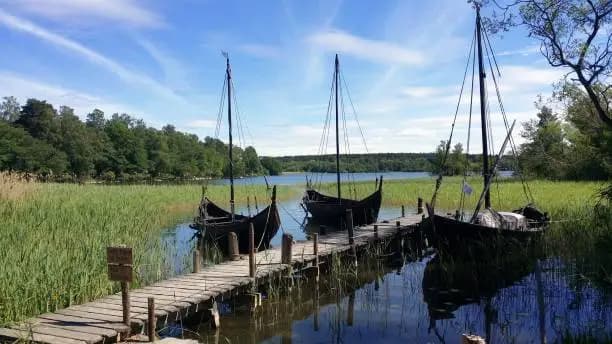
Birka, on the island of Björkö in Lake Mälar, is one of Scandinavia's best-preserved Viking sites. A UNESCO World Heritage site, it encompasses an archaeological museum, over 3,000 burial mounds, and the remains of a fortress, accessible by boat from Stockholm.
Birka is a Viking archaeological site inscribed on the UNESCO World Heritage List, located on the island of Björkö in Lake Mälar, about an hour's boat ride from Stockholm. Founded around 750 AD, it was one of Scandinavia's earliest cities and a major trade hub connecting Northern Europe, Byzantium, and the Arab world. The site comprises a museum, open-air remains, and an extensive burial field that rank among the best-preserved testaments to the Viking Age.
Practical Information at a Glance
- Access: by boat from Stadshuskajen (Stockholm City Hall quay) — crossing takes approximately 1 hour 30 minutes.
- Admission: paid entry (boat ticket and museum usually combined; check current rates with the operator).
- Recommended duration: half a day to a full day.
- Season: the site is primarily open May through September; access is limited outside these months.
- What to wear: hiking shoes recommended — trails cross meadows and hills.
What to See
The site consists of three distinct areas. The Birka Museum displays artifacts from excavations: jewelry, tools, Arab coins, and balance weights illustrating the extent of Viking trade networks. Outside, the Borg (fortress) dominates the island from a hilltop. Finally, the burial field — one of Scandinavia's largest — contains over 3,000 mounds and inhumation graves.
History and Context
Birka flourished between roughly 750 and 975 AD. Its position on Lake Mälar, a gateway to the Baltic, made it a redistribution hub for furs, slaves, amber, and silks. The Frankish monk Ansgar visited twice in the 9th century to evangelize the region — the first attempt at Christianizing Sweden. The city was abandoned around 975, likely in favor of Sigtuna. UNESCO inscribed Birka and Hovgården on the World Heritage List in 1993.
Highlights of Your Visit
The Burial Field
Some 3,000 burial sites cover the slopes around the city. Excavations in the 19th century, led by Hjalmar Stolpe, unearthed richly furnished graves, including that of a Viking warrior woman identified by DNA analysis in 2017 — a discovery that reignited debate about women's roles in Viking society.
The Borg and Ramparts
The remains of the palisade and elevated fortress offer a clear reading of the site's defensive topography. From here, views of Lake Mälar give a vivid sense of the strategic position this city once held.
The Museum
Small but rich in detail, it contextualizes the objects found on-site: bronze balance weights, imported glass beads, Arab dirham coins. These artifacts vividly demonstrate the vast reach of Viking trade routes.
Photography Tips
The golden late-afternoon light raking across the burial mounds is particularly striking. Photograph the funeral mounds from the heights of the Borg to capture their density. Inside the museum, artificial lighting is dim: a fast lens or high ISO sensitivity helps. No known photography restrictions on the outdoor site.
Location and Access
Birka sits on the island of Björkö in Lake Mälar, approximately 30 km west of Stockholm. Access is exclusively by boat from Stadshuskajen, the City Hall quay in Stockholm. Several operators offer guided excursions combining the crossing and site visit. The island is not accessible by car. The outdoor terrain is hilly; accessibility for people with mobility limitations is limited on outdoor trails.
Nearby Attractions
- Hovgården — Viking royal site on the neighboring island of Adelsö, inscribed with Birka on the UNESCO list; accessible by boat from Björkö.
- Sigtuna — Sweden's first Christian city, founded shortly after Birka's abandonment; runic stones and medieval lanes on the shores of Lake Mälar.
- Stockholm City Hall — departure point for boats to Birka; the Golden Hall and tower can be visited before boarding.
Frequently asked questions
The site is primarily open May through September. Summer offers the longest days and most stable navigation conditions on Lake Mälar.
By boat from Stadshuskajen (City Hall quay). The crossing takes approximately 1 hour 30 minutes. There is no road access to the island of Björkö.
During peak season (July-August), advance booking of your boat ticket is strongly recommended, as capacity on vessels is limited.
Some operators offer combined Birka-Sigtuna circuits by boat. Check available itineraries according to season, as schedules vary.
Yes. The boat crossing and open-air mounds generally appeal to children. Bring shoes suitable for walking on grassy, hilly terrain.
No photography restrictions are noted for visitors. Indoor lighting is subdued; using a high ISO setting improves results without flash.
Interested in this visit?
We can include it in your personalised itinerary.