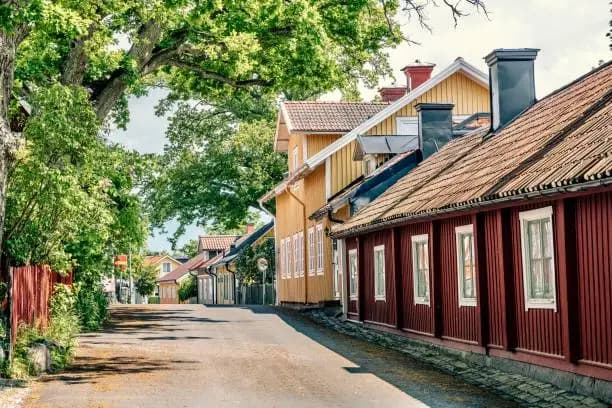
Sigtuna
Sigtuna
Founded around 980, Sigtuna is Sweden's oldest inhabited town. Romanesque church ruins, runic stones and a medieval main street just an hour from Stockholm.
Sigtuna is considered Sweden's oldest inhabited town, founded around 980 on the shores of Lake Mälaren. Just an hour from Stockholm, it preserves a medieval main street, the ruins of Romanesque churches, and a human-scaled town center. It's a rare destination where Viking and Christian history are legible directly in the urban landscape.
Quick practical guide
- Getting there from Stockholm: Arlanda Express or pendeltåg train to Märsta, then a regional bus to Sigtuna (roughly 1 hour total).
- Recommended length of stay: half a day covers the historic center; a full day if you explore the lake surroundings.
- Entry: the main street and church ruins are free to access. Sigtuna Museum is a paid attraction.
- Dress code: no specific requirements for outdoor sites.
What to see
Stora gatan (Great Street) is one of Sweden's oldest streets still in use today. It's lined with colorful wooden houses, artisan shops, and cafés. Five medieval stone church ruins are scattered throughout the town: Sankt Per, Sankt Lars, Sankt Olof, Sankt Gertrud, and Mariakyrkan. Only the latter remains consecrated and in active use.
History and context
Sigtuna was founded by King Erik Segersäll around 980, shortly after Sweden's Christianization. It quickly became the country's first urban and commercial center, minting its own coins—the earliest known Swedish coinage. Its decline began in the 12th century, when Stockholm took over as the economic hub. This demographic setback paradoxically preserved its medieval fabric.
Highlights of a visit
The Romanesque church ruins
Five red sandstone ruins are scattered throughout the town within easy walking distance. Sankt Per and Sankt Lars are the best preserved. Their bare walls, covered in moss, create a striking contrast with the colorful houses nearby. Access is free year-round.
Mariakyrkan
St. Mary's Church, built in the 13th century by Dominican monks, is Sigtuna's only medieval church still in active use. It preserves original interior frescoes and period furnishings. Entry is free outside of services.
Runic stones
Several Viking runic stones are visible throughout the town and immediate surroundings. Some are built into the walls of the church ruins, reused as construction material—a telling detail of the abrupt transition from paganism to Christianity.
Sigtuna Museum
The Sigtuna Museum displays archaeological collections from local excavations: medieval coins, Viking objects, ceramics. It provides a clear chronological narrative of the town's history.
Photography tips
Morning light is ideal on Stora gatan before shops open. Church ruins shot from below, with sky as backdrop, photograph well in all seasons. Autumn foliage around the ruins adds color depth. There are no photography restrictions at outdoor sites.
Etiquette and visiting rules
At Mariakyrkan, silence and respectful attire are expected during services. Switch your phone to silent before entering. Photography is generally permitted outside of ceremonies, but check posted guidelines at the entrance.
Location and access
Sigtuna lies on the northern shore of Lake Mälaren, in Stockholm County (Stockholms län), approximately 45 km northwest of central Stockholm and very close to Arlanda Airport. The historic center is entirely walkable. Wheelchair accessibility is adequate on Stora gatan, but church ruins sit on uneven terrain.
Nearby attractions
- Arlanda Airport — just a few kilometers away, a convenient entry point for combining Sigtuna with arrival or departure.
- Uppsala — approximately 30 km to the north, with its Gothic cathedral and medieval university, a natural extension of a history-focused day.
- Skokloster Castle — 17th-century Baroque castle on Lake Mälaren, accessible by boat from Sigtuna in season.
Frequently asked questions
Summer (June–August) offers the longest days and access to Lake Mälaren cruises. Autumn is prized for the colors around the ruins. Winter is quiet and photogenic under snow, though some tourist services reduce their hours.
Yes. Public transport takes roughly one hour. Half a day covers Stora gatan, the ruins, and Mariakyrkan. Plan a full day if you add the museum and a lakeside walk.
Yes, the outdoor ruins are free to access year-round with no opening hours or ticketing. Only Sigtuna Museum is a paid attraction.
Yes, both towns are connected by bus or car (about 30 km apart). A well-planned day allows you to visit Sigtuna in the morning and Uppsala in the afternoon, or vice versa.
Sigtuna Museum offers guided tours in season, and some local agencies organize walking circuits through the historic center. Contact the local tourism office for availability.
Want to discover this destination?
Our local advisors design your tailor-made trip.