Uppsala
Uppsala
Uppsala combines a Gothic cathedral, the Viking site of Gamla Uppsala, Scandinavia's oldest university and the legacy of Carl von Linné — all within 40 minutes by train from Stockholm.
Uppsala is Sweden's fourth-largest city, roughly 70 km north of Stockholm. Home to Scandinavia's oldest university, it boasts a Gothic cathedral dominating the plain, a royal castle and Viking mounds within cycling distance. The city blends vibrant student life with dense medieval heritage, never veering into tourist folklore.
Quick Facts
- Access from Stockholm: direct train from Stockholm Central, journey around 40 minutes (SJ or Upptåget).
- Recommended duration: a full day for the main sites; two days to explore the surroundings and museums.
- Getting around: compact city center, walkable or bikeable; bike rentals available throughout town.
- Accessibility: historic center partially accessible; some sites (mounds, castle) have elevation changes.
What to See
The Uppsala Cathedral (Domkyrkan) is Scandinavia's largest religious building. Its two Gothic spires reach 118 meters. Inside rest King Gustav Vasa and botanist Carl von Linné. A short walk away, Uppsala Castle (Uppsala slott), built in the 16th century on a hilltop, offers sweeping views over the city.
The University of Uppsala, founded in 1477, shapes the academic quarter: the Carolina Rediviva library, Linnaeus Botanical Garden (Linnéträdgården), the Gustavianum museum with its 17th-century anatomical theater. Five kilometers north, the Gamla Uppsala site comprises three major royal Viking-age mounds and a medieval church.
History and Context
Uppsala was Sweden's religious and political center before Stockholm. The archbishopric permanently settled here in the 15th century. The university, Scandinavia's oldest, attracted scholars like Celsius and Linnaeus from the 18th century onward. Gamla Uppsala, set apart from today's city, was the heart of Swedish power in pre-Christian times: medieval sources locate a grand pagan temple there.
Highlights of a Visit
Uppsala Cathedral
Built from 1270, completed in the 15th century, renovated after a 1702 fire. The royal tombs, side chapels and treasury (medieval liturgical textiles) deserve careful attention. Entry to the nave is free.
The Gustavianum
A 17th-century university building, now a museum. Its circular anatomical theater beneath a dome is among Europe's best preserved. Egyptian and Nordic collections round out the visit.
Gamla Uppsala
Three royal burial mounds dating to the 5th-6th centuries command an open plain. An on-site museum contextualizes the Viking period and archaeological excavations. Gamla Uppsala Church, Romanesque, is one of Sweden's oldest still in use.
Linnaeus Botanical Garden
A reconstruction of the garden Carl von Linné administered in the 18th century, adjacent to his house (Linnémuseet). The beds follow Linnaean botanical classification.
Photography Tips
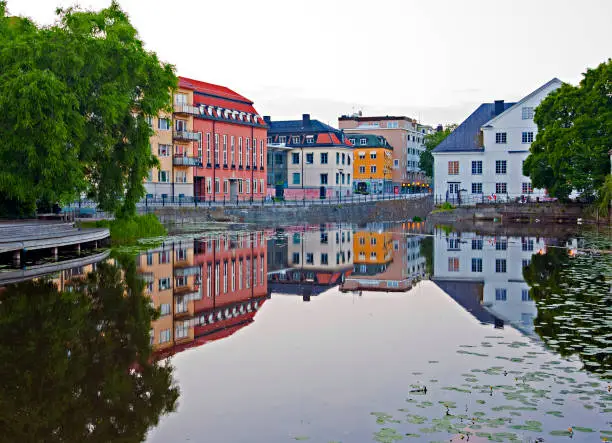
The cathedral photographs beautifully from the Fyrisån bridge in late afternoon, when side-lighting catches the spires. The Gamla Uppsala mounds are most photogenic early morning, when mist still cloaks the plain. Inside the Gustavianum, the anatomical theater benefits from natural overhead light — avoid flash.
Location and Access
Uppsala sits in Uppland county, roughly 70 km north of Stockholm. The central station (Uppsala C) is a 10-minute walk from the cathedral. Urban buses serve Gamla Uppsala from the center. English-language guided tours are offered by the local tourism office, notably for the cathedral and castle.
Nearby
- Gamla Uppsala — Viking archaeological site with royal mounds and museum, 5 km north of the center.
- Uppsala Cathedral — Scandinavia's largest church, royal tombs and medieval treasury.
- Uppsala Castle — Renaissance fortress on the hilltop, panoramic city views.
- Gustavianum — university museum with 17th-century anatomical theater.
- Linnémuseet and Botanical Garden — Carl von Linné's house and garden, UNESCO World Heritage site.
Frequently asked questions
Spring (April-May) and summer (June-August) offer the best conditions: long days, gardens open, vibrant student life. In April, the Walpurgis Night celebration (Valborg) draws thousands of students along the river — unique atmosphere but large crowds.
Yes. The train from Stockholm Central takes around 40 minutes. One day allows you to cover the cathedral, Gustavianum, the castle and Gamla Uppsala, provided you start early.
Access to the nave is free. The treasury (skattkammaren) requires admission. Check opening hours on-site, as the cathedral may close for religious services.
Several urban bus lines connect Uppsala C to Gamla Uppsala in around fifteen minutes. Cycling is also feasible on well-marked bike paths.
No strict rules apply, but respectful attire is expected in this active Lutheran place of worship. Avoid beach wear.
Yes. The Gamla Uppsala museum offers activities for children. Linnaeus Botanical Garden and Viking mounds readily captivate younger visitors. The center is stroller-friendly on main routes.
Want to discover this destination?
Our local advisors design your tailor-made trip.