Dalarna and Lake Siljan
Surrounding a lake formed by a meteorite, Dalarna concentrates red-painted villages, Dalahäst workshops and the country's most traditional Midsommar celebration.
Dalarna, or Dalarna in Swedish, occupies the geographical centre of the country, approximately 280 kilometres north-west of Stockholm. It is a region of coniferous forests, glacial lakes and low hills that peak at 1,200 metres in the Fulufjället massif, near the Norwegian border. Lake Siljan, which structures the entire region, stretches across 290 km² within a meteorite impact crater formed 360 million years ago, one of Europe's oldest and largest. This geological peculiarity has shaped a fertile limestone soil, rare in Suède, which explains the density of agricultural villages around its shores.
For Swedes, Dalarna embodies the country's heartland, what is called here kulturbygd, cultural heritage territory. It is in the red-painted farmsteads of Falun, around Rättvik, Leksand and Mora, that regional costumes, ancient dialects and craft practices preserved elsewhere by modernisation have been maintained. The village of Nusnäs, a ten-minute drive from Mora, still houses two family workshops that hand-carve and paint the Dalahäst, the small orange wooden horse that became a national emblem. Production remains artisanal, approximately 200,000 pieces per year, and the workshops can be visited on weekdays.
The region also has significant industrial heritage. The Falun copper mine, exploited from the thirteenth century until 1992, supplied at one point two-thirds of European copper and gave its name to the famous Falun red, the ferrous pigment that still colours the majority of the country's wooden houses today. The site, inscribed as a UNESCO World Heritage site in 2001, can be visited by descending 67 metres underground into the original galleries.
Around Siljan, villages string together according to a consistent pattern: a wooden church on the water's edge, a landing point for kyrkbåtar, these long rowing boats of 10 to 12 metres historically used to attend church, and a sandy beach. At Tällberg, perched 80 metres above the lake, a dozen historic farmsteads have been converted into inns. At Rättvik, the wooden jetty Långbryggan extends 625 metres into the lake, a legacy of nineteenth-century steam boats. Mora, at the northern end, is the most animated town, the starting point for the Vasaloppet, a 90 km cross-country ski race to Sälen that attracts more than 15,000 participants each first Sunday in March.
Midsommar, celebrated on the Friday closest to the summer solstice, takes its densest form here. At Leksand and Rättvik, processions in traditional costume gather several thousand people around the maypole, the majstång, erected according to a local protocol unchanged since the eighteenth century. Hotels are fully booked six months in advance for this period.
On the table, Dalarna cultivates a cuisine of lakes and forests: klimp (potato dumplings stuffed with pork), cold-smoked salmon from Siljan, aged goat cheese from Våmhus farmsteads, and tunnbröd, a dry flat bread baked on round hotplates, the foundation of kams, the local peasant speciality.
To discover
Lake Siljan drive. A 170 km loop via Rättvik, Tällberg, Leksand, Mora and Sollerön, the lake's central island, to be covered in one day with stops in traditional village streets and swimming from sandy beaches.
Falun copper mine. Descent 67 metres underground into galleries exploited since the thirteenth century, where the red ochre pigment that gives colour to half of Swedish houses is still extracted today.
Dalahäst workshops at Nusnäs. Visit to the two family workshops Olsson and Grannas, where wooden horses are still hand-hewn with an axe, sanded, hand-painted and signed. Allow 1 hour and the possibility to paint your own.
Midsommar at Leksand. The country's most traditional solstice celebrations, with procession in regional costume, raising of the flower-decorated pole around 2 p.m., and dances until the night that doesn't fall, around 21 June.
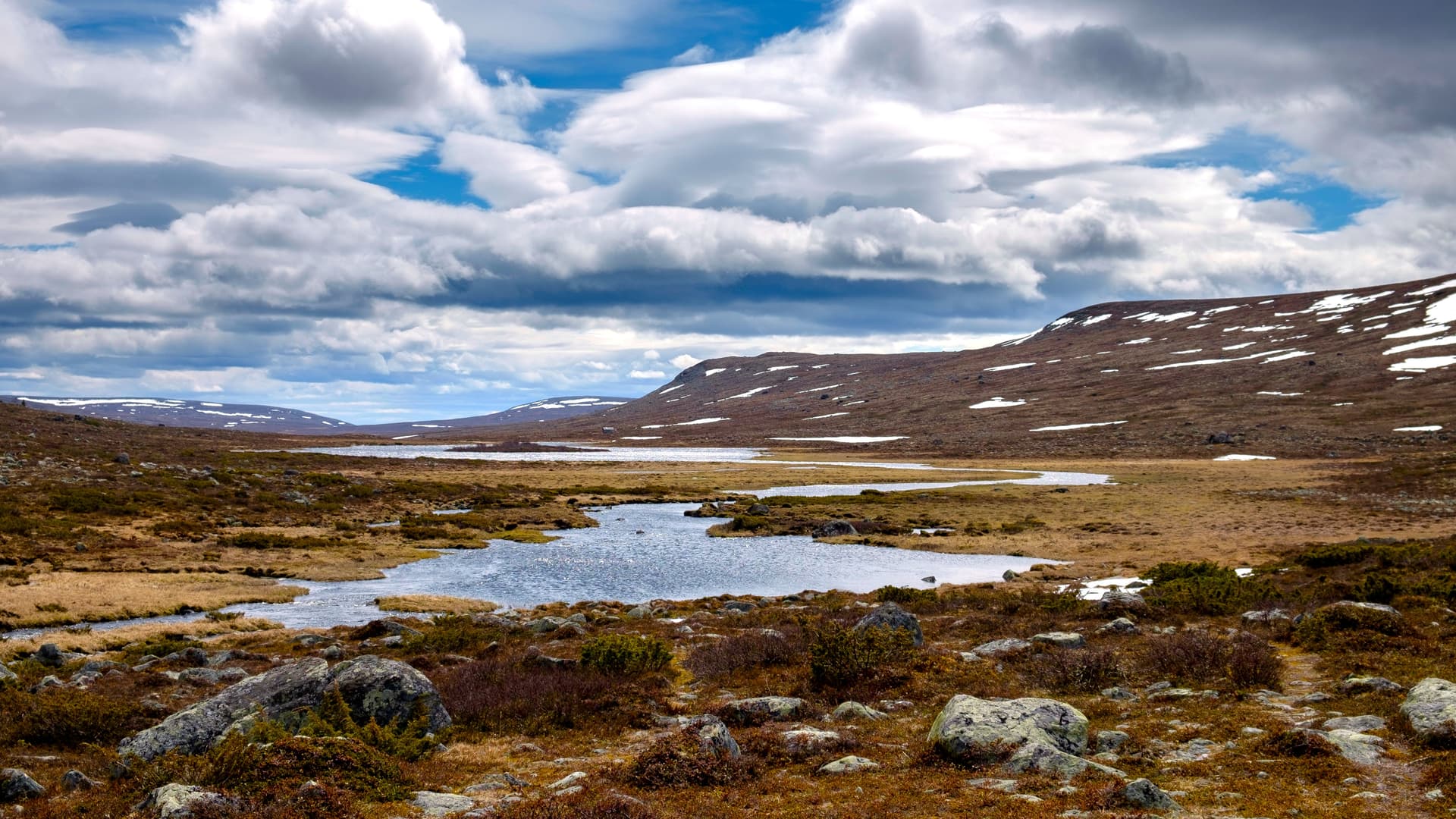
Fulufjället National Park. 3 hours' drive west of Mora, a subarctic tundra plateau home to the Njupeskär waterfall, 93 metres high, and Old Tjikko, a spruce whose roots are dated to 9,550 years old.
When to visit
Dalarna follows a marked continental climate. The widest window for visiting runs from late May to late September, with daytime temperatures of 18 to 22 °C in July and August, cool evenings around 10 °C, and light lingering until 11 p.m. in June. The Midsommar period, around 21 June, is the most culturally charged but also the tightest for accommodation, to be booked six months in advance. September offers autumn colours on birch and aspen forests, with days still mild around 14 °C and far fewer visitors.
In winter, from December to March, the region transforms into cross-country skiing terrain. The lake freezes completely from January to March, snow cover reaches 40 to 60 cm, and temperatures regularly drop between -10 and -20 °C. This is the season for the Vasaloppet and maintained cross-country tracks around Mora and Orsa. We advise against April, early May and late October to November: snow melts or falls as rain, lakes are impassable and many seasonal sites close.
Practical advice
Allow 2 to 3 full days to drive around Siljan and visit Falun, more if you include Fulufjället or the Orsa region and its predator park. Dalarna is accessible by 3 hours of direct train from Stockholm Central to Mora, via Borlänge and Falun, making it one of the country's easiest regions to reach. A rental car remains essential on site to reach villages, workshops and trails. No regional airport has regular commercial flights; everything goes through Arlanda in Stockholm.
The region combines very naturally with Stockholm and its archipelago at the beginning or end of a stay, in a loop of 8 to 10 days. For travellers heading next to Swedish Laponia, Mora is a logical stopover on the road or overnight train to Kiruna. The combination with the west coast or Scania is however geographically incoherent, these regions being 6 to 8 hours' drive away. Accommodation comfort is good, with a network of farm inns (Klockargården at Tällberg, Green Hotel at Tällberg, Hotell Siljan at Rättvik) that offer a warm standard without ostentatious luxury. This is a destination that particularly appeals to contemplative travellers, families with children (short distances, lake swimming, craft workshops) and enthusiasts of living culture rather than hikers seeking elevation.